

How to Search for State-of-the-Art? Inventions to be patented are either absolutely novel or an improvement suggested to the previous or existing solutions present in the market. As the innovation industry evolves every decade, various solutions to existing problems are identified and filed with patent offices. These solutions are more economical, less complex, and easily integrated with emerging technologies. As a matter of fact, the twenty-year lifecycle of a patent gives ample time to evolve around an existing patent and identify alternative ways that are less costly, more efficient, and easily adaptable to state-of-the-art technologies. This makes the problem exist however solutions corresponding to it are now diversified. Hence, a State-of-the-art (SOTA) is majorly a need of Fortune 500+ companies to build and strengthen their patent portfolio by understanding patents solving one or more problems, and identifying novel techniques to solve the problem which is less complex and more economical from a problem standpoint. It is to be understood that a basic need to State-of –the-art is also to understand patents issued or applications published within the last twenty years to see and understand a technology area or a technical problem and its solutions. Some tips that shall be considered while conducting a SOTA search include: · Twenty Year Lifecycle of patent · Covering Active/Inactive patents · Relying on Class (IPC/CPC/U.S.) based search · Conducting Broad search with respect to the technological problem · Limiting the search to claims, if possible to gather relevant patent data-set It is recommended to exclude patents before twenty years as the technology stands outdated. The patent data-set gathered serves as the right guide to review and understand various solutions to a technical problem. In case of any queries, please reach PatentManiac at mail@patentmaniac.com.
How to conduct an effective FTO Search
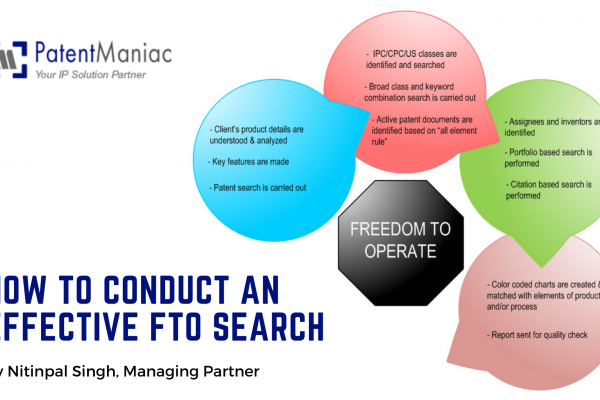
How to conduct an effective FTO Search A Freedom-to-Operate (FTO) search is performed to understand enforceable patents that can become a cause of patent infringement while launching a product or a service in a jurisdiction. From an effective launch standpoint, it is one of the crucial steps to evaluate and judge if the product developed has already been covered by a patent active in the country where the product is to be launched. Specifically, the features associated with the product are generally checked if they are covered in the claims of enforceable patents. In order to perform an effective FTO search, people should understand core features around the product and perform the search accordingly. From an IP perspective, the claims are reviewed and the degree of overlap with respect to core features of the product is evaluated. Once the search is performed and the closest enforceable patents are identified, a one-to-one comparison of core features is done to finalize the risk analysis. The risk majorly is classified into below aspects: Changing / Adding core features within the product without increasing costing of the overall product. Licensing with companies owing the patent covering the core features of the product. It has to be understood that a comprehensive FTO search shall be conducted to uncover any potential enforceable patent that can also be considered while developing around the product to make is complex and less infringing. This strategy is generally used in different technologies to plan and extend features in the product. From a product development perspective, both products and services are considered equal in terms of conducting an FTO search. To put it simpler, any service (including SAAS) is equally susceptible to patent infringement while launching in one or more jurisdiction. It is a common perception that the FTO search is product driven. However, this perception is NOT completely true. Sometimes, both product and service provided by the product are launched together. In these circumstances, one needs to understand the nature of FTO that needs to be checked. For example, if someone is launching a Baby Doll with an AI-based technology to understand and respond to a kid’s enquiry, one should consider the AI-based technology being part of the core feature to be considered for the FTO search rather than the design of the baby doll. Hence, one needs to be well aware of the core features in the product or service that is to be checked via an FTO search to avoid infringement. Quick pointers for an effective FTO search will be: Classifying core features of the product to be launched. Conducting patent search within 20 years from the date of filing in the jurisdiction where the product is to be launched. Conducting the broadest level search on “Claim” section of the search tool to uncover everything around the product literature. Classifying the risk around the enforceable art identified in terms of product re-development or licensing. In case of any queries, please reach PatentManiac at mail@patentmaniac.com.