
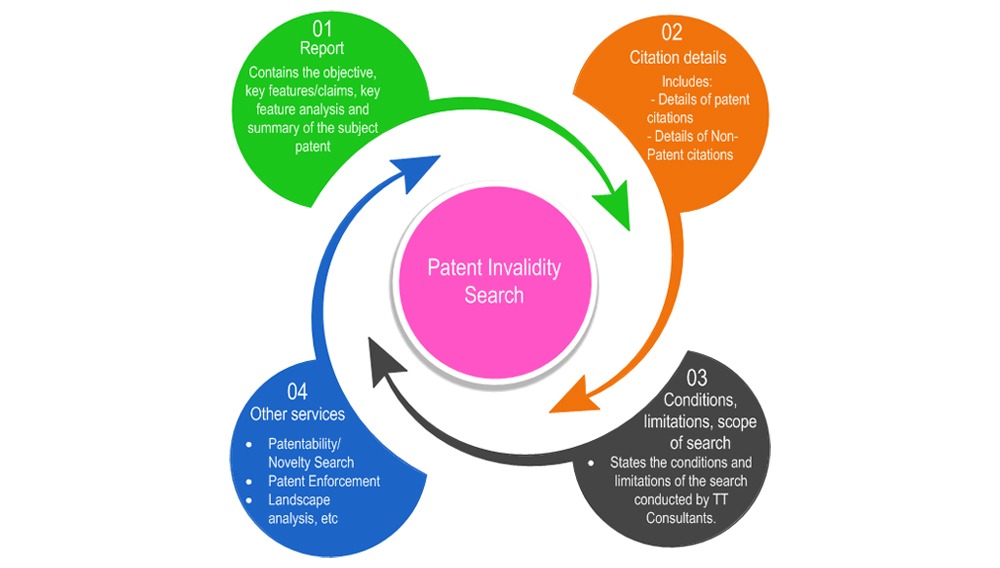
Most companies invest heavily in patent filing and portfolio building — but when a legal or licensing dispute arises, they often overlook one of the most powerful defensive tools in IP strategy: You don’t always need to fight back with a new patent — sometimes, you win by proving the other side’s patent shouldn’t exist. That’s where Patent Invalidity Searches (also called Opposition / Revocation Studies) come in. One Prior Art Reference Can Change the Entire Case A classic example comes from the Apple vs. Samsung smartphone battle. Apple accused Samsung of infringing its “bounce-back” UI patent and demanded huge damages.Samsung’s legal team uncovered an older Japanese patent showing similar functionality. Result: Apple’s core patent claims were invalidated — instantly weakening their leverage. A single piece of prior art shifted the balance of power. When Do Companies Use Invalidity Searches? Below is an illustration of typical usage distribution in real-world scenarios: Litigation Defense – 50% Pre-Licensing / Royalty Negotiations – 30% M&A / Technology Acquisition Due Diligence – 15% Competitive Strategy / Portfolio Monitoring – 5% This visual demonstrates how invalidity searches are most frequently used to defend against litigation and reduce exposure, but they also play a critical role in licensing and strategic acquisitions. 5-Step Framework for a Strong Invalidity Strategy Break down patent claims carefully — don’t rely solely on the abstract. Search beyond patent databases — include theses, standards documents, manuals, conference papers. Examine older or obscure jurisdictions — Japan, Korea, Russia, WIPO documents often reveal overlooked prior art. Map each claim element to prior art — build a clear visual comparison. Align findings with legal invalidation grounds — focus on novelty and obviousness. Why It’s Called a “Silent Weapon” Most disputes do not even reach court once solid prior art is presented.Conversations shift, royalty demands soften, and settlements become favorable. It is not aggression — it is strategic disarmament. Final Thought If your IP strategy focuses only on filing patents but ignores invalidation as an offensive-defense tool, you are fighting with half your arsenal. Whether you’re a startup facing licensing threats, a corporation defending litigation, or a law firm advising clients — an invalidity search could be the difference between paying millions or walking free. If you’d like to explore real-world invalidity strategies or see a sample claim mapping, let’s connect.
Provisional Patents: The Smart First Step for Inventors
Every great invention starts with an idea. But in today’s fast-moving world, the real challenge is protecting that idea before someone else brings it to life. That’s where a Provisional Patent Application (PPA) comes in — a simple, affordable, and strategic first step for inventors. What is a Provisional Patent? A provisional patent is essentially a placeholder filed with the U.S. Patent and Trademark Office (USPTO). It doesn’t give you a granted patent, but it does: Secure an official filing date (your “priority date”). Allow you to use the term “Patent Pending” for 12 months. Give you time to refine your invention, attract investors, or test the market before committing to a full patent. Why It’s a Smart Move Cost-Effective – Filing fees start as low as $60 for micro-entities. Flexible – You can update your invention and file multiple PPAs before submitting a full non-provisional patent. Strategic – Investors and partners take “Patent Pending” seriously, making it easier to gain credibility. Common Misconceptions “It guarantees a patent.” → Not true. You must still file a non-provisional within 12 months. “A vague description is enough.” → No. Your PPA must describe your invention clearly so others could replicate it. Final Thought Think of a provisional patent as a safety net for your innovation journey. It buys you time, protects your priority, and signals to the world that your idea is worth something. For any inventor — especially startups and individual innovators — it’s the smartest first step toward turning an idea into a protected innovation.

Emerging Patent Trends in 2025: How Corporations Should Adapt Their #IPStrategies
The world of #intellectualproperty is evolving rapidly, and 2025 brings both new challenges and unprecedented opportunities for corporations committed to #innovation. Trends such as #artificialintelligence, digital health, sustainable technologies, and global competition are reshaping how businesses protect their ideas and capitalize on their R&D investments. Shifting Landscapes: What’s Changing in Patent Strategy? With technologies advancing at breakneck speed, traditional approaches to patenting may no longer suffice. AI-driven inventions, complex digital platforms, and Industry 4.0 smart manufacturing require new filing strategies and careful attention to global IP rules. Companies in renewable energy, healthcare, and connected devices must now navigate stricter patentability criteria and changing international enforcement standards to truly safeguard and monetize their innovations. AI, Sustainability, and Globalization: The Big Patent Drivers AI is at the heart of the current innovation race, and countries like China, the US, and India are leading in AI patent filings. The growth in green tech IP reflects a worldwide focus on climate change and sustainability, with patents driving competition in solar, battery, and carbon solutions. Additionally, digital healthcare and telemedicine are raising new questions about patenting data use and ensuring system interoperability. Why Companies Must Rethink Their IP Approach Competitive Edge: Companies with proactive, globally aligned IP strategies are best positioned to attract investors and secure partnerships. Value Creation: A robust patent portfolio isn’t just defensive; it’s an asset that can drive licensing, commercial deals, and sustained growth. Regulatory Readiness: Understanding and planning for new IP regulations and digital risks is vital to prevent costly litigation or lost rights. Taking Action: What Should Corporations Do? Review and refresh your #patentportfolio regularly for relevance and global coverage. Collaborate with experienced IP partners who understand emerging tech and worldwide compliance. Consider #patentanalytics to identify innovation gaps, competitor moves, and business opportunities. Support in-house R&D teams with patent education and strategy workshops to align innovation with business objectives. Engage in IP audits and future-proof your protection by anticipating regulatory and technology shifts. Ready to Innovate with Confidence? Navigating the changing world of patents requires expertise, insight, and agility. At PatentManiac, our team helps corporations unlock the potential of their intellectual property with tailored patent filing, analytics, and strategy solutions. Discover how PatentManiac.com can elevate your IP strategy and maximize innovation value. #Patents #Innovation #IntellectualProperty #IPStrategy #AI #GreenTech #DigitalHealth #CorporateInnovation #IP2025 #PatentFiling #IPServices
How to file a U.S. design patent application?
How to file a U.S. design patent application? Protecting ornamental designs is one of the crucial aspects of manufacturing companies at a global level today. Since the products consistently are driven through customers’ changing requirements, their respective designs improved. It is understood that design patents provide protection of the ornamental design or shape of the product for some years in a given jurisdiction. However, it Is equally crucial to understand what portion of the design needs to be protected. Quality design patent applications require less time to get approved from the patent office as compared to a utility patent. However, components within the product to be protected have to be clearly laid out in terms of views to be compliant with USPTO requirements. Some key points to be taken care of while filing a design patent include: Understanding the product based on its uniqueness ornamentally. Taking care of internal components within the product to be claimed or not Defining all claimable parts of the product and discriminating with the non-claimable part Providing USPTO compliant shading, lines, color distinctions of claimable part from non-claim part Including necessary ornamental representation of parts of the product Complying to 37 CFR requirements laid out by USPTO Like in utility patent applications, the design patent applications are subject to the examiner’s review of prior patents and literature available in the market. Hence, it is recommended to conduct a thorough design patent search based on keywords, classes (Locarno, Domestic design classes), and their combination to ensure the patent application is not susceptible to easy rejection from USPTO. PatentManiac provides high-quality design patent filing services with competence, precision, and quick turnaround time. In case of any questions, please reach out to us at mail@patentmaniac.com or visit www.patentmaniac.com
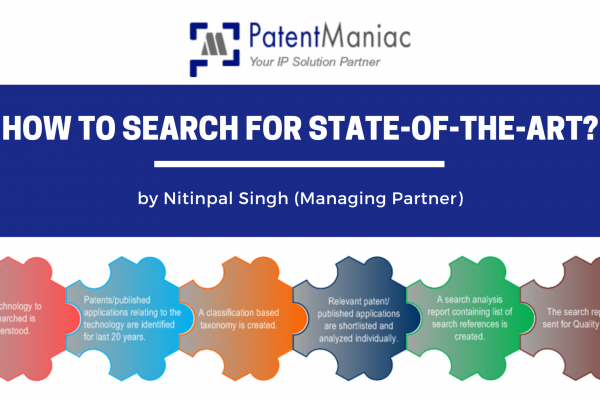
How to Search for State-of-the-Art?
How to Search for State-of-the-Art? Inventions to be patented are either absolutely novel or an improvement suggested to the previous or existing solutions present in the market. As the innovation industry evolves every decade, various solutions to existing problems are identified and filed with patent offices. These solutions are more economical, less complex, and easily integrated with emerging technologies. As a matter of fact, the twenty-year lifecycle of a patent gives ample time to evolve around an existing patent and identify alternative ways that are less costly, more efficient, and easily adaptable to state-of-the-art technologies. This makes the problem exist however solutions corresponding to it are now diversified. Hence, a State-of-the-art (SOTA) is majorly a need of Fortune 500+ companies to build and strengthen their patent portfolio by understanding patents solving one or more problems, and identifying novel techniques to solve the problem which is less complex and more economical from a problem standpoint. It is to be understood that a basic need to State-of –the-art is also to understand patents issued or applications published within the last twenty years to see and understand a technology area or a technical problem and its solutions. Some tips that shall be considered while conducting a SOTA search include: · Twenty Year Lifecycle of patent · Covering Active/Inactive patents · Relying on Class (IPC/CPC/U.S.) based search · Conducting Broad search with respect to the technological problem · Limiting the search to claims, if possible to gather relevant patent data-set It is recommended to exclude patents before twenty years as the technology stands outdated. The patent data-set gathered serves as the right guide to review and understand various solutions to a technical problem. In case of any queries, please reach PatentManiac at mail@patentmaniac.com.
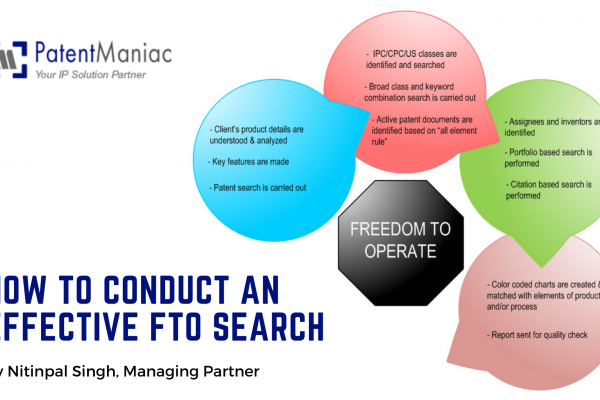
How to conduct an effective FTO Search
How to conduct an effective FTO Search A Freedom-to-Operate (FTO) search is performed to understand enforceable patents that can become a cause of patent infringement while launching a product or a service in a jurisdiction. From an effective launch standpoint, it is one of the crucial steps to evaluate and judge if the product developed has already been covered by a patent active in the country where the product is to be launched. Specifically, the features associated with the product are generally checked if they are covered in the claims of enforceable patents. In order to perform an effective FTO search, people should understand core features around the product and perform the search accordingly. From an IP perspective, the claims are reviewed and the degree of overlap with respect to core features of the product is evaluated. Once the search is performed and the closest enforceable patents are identified, a one-to-one comparison of core features is done to finalize the risk analysis. The risk majorly is classified into below aspects: Changing / Adding core features within the product without increasing costing of the overall product. Licensing with companies owing the patent covering the core features of the product. It has to be understood that a comprehensive FTO search shall be conducted to uncover any potential enforceable patent that can also be considered while developing around the product to make is complex and less infringing. This strategy is generally used in different technologies to plan and extend features in the product. From a product development perspective, both products and services are considered equal in terms of conducting an FTO search. To put it simpler, any service (including SAAS) is equally susceptible to patent infringement while launching in one or more jurisdiction. It is a common perception that the FTO search is product driven. However, this perception is NOT completely true. Sometimes, both product and service provided by the product are launched together. In these circumstances, one needs to understand the nature of FTO that needs to be checked. For example, if someone is launching a Baby Doll with an AI-based technology to understand and respond to a kid’s enquiry, one should consider the AI-based technology being part of the core feature to be considered for the FTO search rather than the design of the baby doll. Hence, one needs to be well aware of the core features in the product or service that is to be checked via an FTO search to avoid infringement. Quick pointers for an effective FTO search will be: Classifying core features of the product to be launched. Conducting patent search within 20 years from the date of filing in the jurisdiction where the product is to be launched. Conducting the broadest level search on “Claim” section of the search tool to uncover everything around the product literature. Classifying the risk around the enforceable art identified in terms of product re-development or licensing. In case of any queries, please reach PatentManiac at mail@patentmaniac.com.
How to Get a Patent in the US?
The United States is the innovation hub for various technologies based inventions that are filed with the patent office (USPTO) directly or with a foreign priority. Every year, hundreds of thousands of patent applications (Provisional or Non-provisional) are filed with the U.S. patent office. Each application covers a novel idea that requires a thorough inspection by examiners of the patent office before issuing a patent. It is to be understood that an idea’s inception needs to follow a set of procedural steps through an experienced patent attorney, who works along with you to interact and prepare the patent application to be accepted by the U.S. patent office. One wrong step can sabotage a complete patent application and lead to thousands of dollars loss. Hence, from an inventor or company standpoint, it is highly recommended to follow each step comprehensively in order to get a patent on your invention. The steps that are pillars to a strong patent application include: I. Conducting a Patent Search on the Idea – Whether your invention is a novel method, product of both, it is very much important to review what is there in the market (normally termed as Prior Art Search) that is exactly similar or nearly similar to your invention. This step is crucial and acts as a guiding path for polishing your invention and the patent application in general. II. Choosing Patent Application Path – Based on the Patent Search conducted, the patent attorney can discuss the position of your invention with the degree of closeness of the Prior Art identified. Once it is discussed, the attorney can advise to follow one out of provisional and non-provisional. The provisional application gives 1 year to the inventor to improve and finalize the invention so that it doesn’t look similar to what has been identified in the patent search. Otherwise, Non-provisional is recommended. III. Drafting the Patent Application – This is the most crucial and important step in the complete process which defines boundaries in your invention. A carefully written patent application allows easy prosecution and shall cover the boundary of your invention without breaching anyone else. The patent attorney shall write and review the patent application and take inputs from the inventor at each step, so that there is no technical or legal limitation to the claims of the invention. Hiring a right set of legal experts to draft a patent application is really important as it directly controls the patent prosecution cost. IV. Filing the Patent Application – Once the patent application is drafted and reviewed by the patent attorney and inventor, it is ready to be filed with the patent office (USPTO). The U.S. patent office accepts either E-Filing or Paper-filing via a licensed patent agent or attorney registered to practice with the U.S. patent office. It is to be kept in mind that each way of filing the patent application requires the inventor to provide certain information to the patent agent or attorney like Name, Address, Financial Status (for discounted patent filing fee). Once all these details are filled on your behalf by the appointed patent agent or attorney, you receive a filing receipt that the patent agent or attorney will share with you, along with all other documents received from the U.S. patent office. V. Publication of the Patent Application – From the day of filing the patent application, the U.S. patent office publishes the patent application for view to the public within 18 month(s) from the day of filing. This is to ensure that the patent application is open in public domain and can be reviewed directly. Sometimes, for specific technical area(s) that are related to national security, the patent application is not published but issued directly as a patent. VI. Examination of the Patent Application – The published patent application is now allocated to an art unit, which is a technical department of patent examiners who are subject matter experts. This assists in reviewing the application at pace. If the patent examiner allocated from the art unit with the U.S. patent office finds your invention not novel, he/she can issue an objection to the patent application (specifically to the claims of the patent application) and send it over to the appointed patent attorney to respond within a time frame allocated. Based on the type of objection, the patent attorney might consult with the inventor and file a response to the office action with agreement or denial of objection raised. A couple of such office actions are generally common with a patent application. However, that cannot hold true for each idea. VII. Issuing a Patent– Once the examiner and patent attorney have agreed or come to a common standpoint on the patent application, the patent office approves a patent to the inventor and gives the inventor rights to the invention for a period of 20 years from the date of filing. In case of any queries, please reach PatentManiac at mail@patentmaniac.com.

Evidence of Use (EoU Charting) – Best Practice(s)
Evidence-of-Use (EoU) is categorized as one of the most crucial services for patent portfolio managers, patent practitioners, and individual inventors. It is the foremost analysis step to pursue patent litigation or licensing with potential parties. It is advisable to check for potential infringement in order to license the patented technology for monetary benefits. However, the trend has changed over the years. During the patent life-cycle, once the patent has been filed and under the prosecution stage, the patent holders do check for potential infringement on their published claims. Herein, the EOU analysis is of immense use. It is always recommended to be very comprehensive in your analysis while developing these EOU charts for litigation purposes. There are different objectives to be catered while you check for infringement levels. The objective varies from type of licensing to sole monetization or both. In order to develop EOU charts, one must be sure of the objective to be achieved so as to customize the efforts. The most common case is to look for all types of infringers reading on the enforceable patent in a jurisdiction. Herein, one must customize the efforts based on: Dominant players within the technology of the patent Forward Citations of the patent Method/System claim targeted in the patent Checking if the patent falls under certain standards (SEPs) Once the above is understood, the search is well-aligned to identify big players who are potentially capable of licensing or paying royalties. There are numerous approaches to conduct EOU based searches and certain ways of developing infringement charts. The best approach to search and chart an EOU include: Identify/Shortlist/Understand the broadest Independent claim within the patent Conduct a quick search to Identify big players active in jurisdiction and covering the technology disclosed. A strong eye on Citations of the patent, especially the forward citations Conduct a post-art patent search to identify companies with patents in similar technology as disclosed in the patent Conduct Google search (sometimes on E-commerce platforms as well) to identify similar products of infringing parties Referring to multiple documents for a single product charting in case(s) of different versions of same product Use Commercial terms rather than technical terms while framing keyword based approach It is known that there is no standard approach while we conduct the search for Evidence-of-use (EOU). However, a good amalgamation of technology in question, broadness of the claims, time-window, and other essential parameters (Right set of Keywords) allow one approach to be adopted over the other. A sellable Evidence-of-Use (EOU) chart should have the element-by-element mapping of each element and its role being performed by a product being sold. Sometimes, it does require search and reviewing a Trade Secret (which is NOT easily available). For product-based invention, in order to review the infringing party’s product, it is advisable to do proper reverse engineering before going from infringement. Sometimes it does happen that the infringing product is purchased and opened up to see the exact functioning of the infringing product. From a researcher’s standpoint, it is advisable to review the patent with description and NOT rely on claims only. If required, a prosecution history shall also be reviewed to understand the claims being enforced are understood.