
Every great invention starts with an idea. But in today’s fast-moving world, the real challenge is protecting that idea before someone else brings it to life. That’s where a Provisional Patent Application (PPA) comes in — a simple, affordable, and strategic first step for inventors.
What is a Provisional Patent?
A provisional patent is essentially a placeholder filed with the U.S. Patent and Trademark Office (USPTO). It doesn’t give you a granted patent, but it does:
- Secure an official filing date (your “priority date”).
- Allow you to use the term “Patent Pending” for 12 months.
- Give you time to refine your invention, attract investors, or test the market before committing to a full patent.
Why It’s a Smart Move
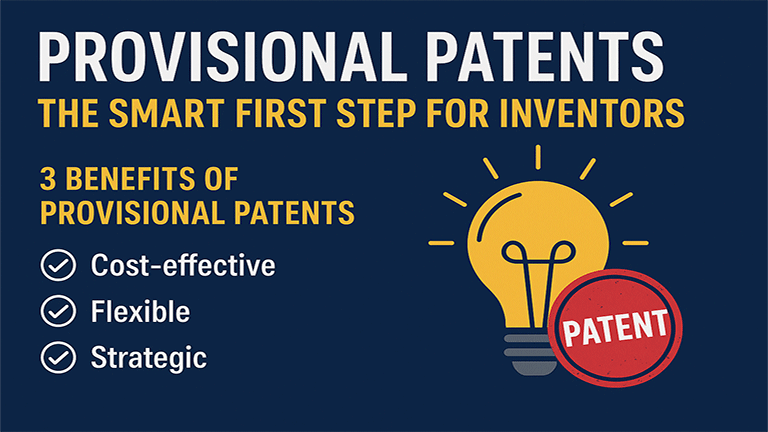
- Cost-Effective – Filing fees start as low as $60 for micro-entities.
- Flexible – You can update your invention and file multiple PPAs before submitting a full non-provisional patent.
- Strategic – Investors and partners take “Patent Pending” seriously, making it easier to gain credibility.
Common Misconceptions
- “It guarantees a patent.” → Not true. You must still file a non-provisional within 12 months.
- “A vague description is enough.” → No. Your PPA must describe your invention clearly so others could replicate it.
Final Thought
Think of a provisional patent as a safety net for your innovation journey. It buys you time, protects your priority, and signals to the world that your idea is worth something. For any inventor — especially startups and individual innovators — it’s the smartest first step toward turning an idea into a protected innovation.
