
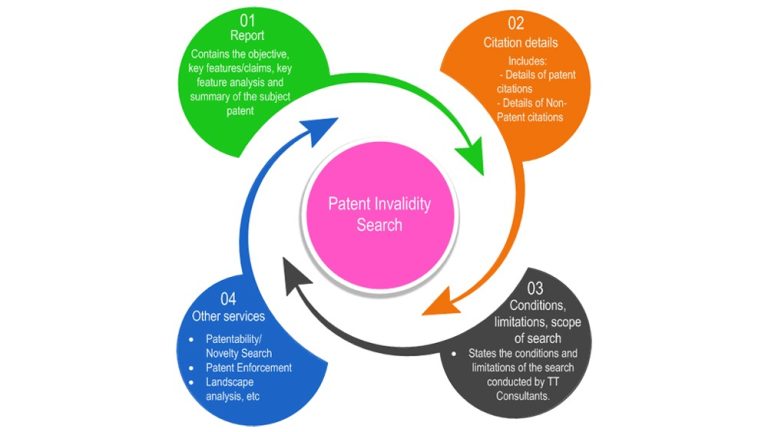
Most companies invest heavily in patent filing and portfolio building — but when a legal or licensing dispute arises, they often overlook one of the most powerful defensive tools in IP strategy:
You don’t always need to fight back with a new patent — sometimes, you win by proving the other side’s patent shouldn’t exist.
That’s where Patent Invalidity Searches (also called Opposition / Revocation Studies) come in.
One Prior Art Reference Can Change the Entire Case
A classic example comes from the Apple vs. Samsung smartphone battle.
Apple accused Samsung of infringing its “bounce-back” UI patent and demanded huge damages.
Samsung’s legal team uncovered an older Japanese patent showing similar functionality.
Result: Apple’s core patent claims were invalidated — instantly weakening their leverage.
A single piece of prior art shifted the balance of power.
When Do Companies Use Invalidity Searches?
Below is an illustration of typical usage distribution in real-world scenarios:
- Litigation Defense – 50%
- Pre-Licensing / Royalty Negotiations – 30%
- M&A / Technology Acquisition Due Diligence – 15%
- Competitive Strategy / Portfolio Monitoring – 5%
This visual demonstrates how invalidity searches are most frequently used to defend against litigation and reduce exposure, but they also play a critical role in licensing and strategic acquisitions.
5-Step Framework for a Strong Invalidity Strategy
- Break down patent claims carefully — don’t rely solely on the abstract.
- Search beyond patent databases — include theses, standards documents, manuals, conference papers.
- Examine older or obscure jurisdictions — Japan, Korea, Russia, WIPO documents often reveal overlooked prior art.
- Map each claim element to prior art — build a clear visual comparison.
- Align findings with legal invalidation grounds — focus on novelty and obviousness.
Why It’s Called a “Silent Weapon”
Most disputes do not even reach court once solid prior art is presented.
Conversations shift, royalty demands soften, and settlements become favorable.
It is not aggression — it is strategic disarmament.
Final Thought
If your IP strategy focuses only on filing patents but ignores invalidation as an offensive-defense tool, you are fighting with half your arsenal.
Whether you’re a startup facing licensing threats, a corporation defending litigation, or a law firm advising clients — an invalidity search could be the difference between paying millions or walking free.
If you’d like to explore real-world invalidity strategies or see a sample claim mapping, let’s connect.
